
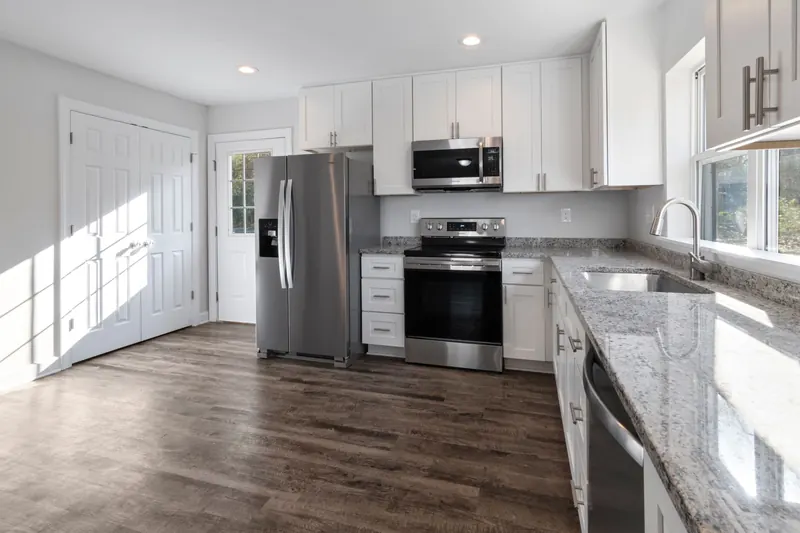
This is probably the question we are asked most often in the showroom. Someone has a new kitchen on order, or has just moved into a house with tired tiles, and they want a hard floor that looks like wood without the price or the worry of real wood. They have seen LVT and laminate side by side on our stands, and from a couple of feet away they can look almost identical.
They are very different floors underneath, and in a kitchen that difference matters.
What each one is made of
Laminate has a core of high-density fibreboard, which is wood fibre pressed together with resin. On top of that is a printed layer with the wood or stone pattern, and over that a very hard clear surface. The boards click together and float on an underlay.
LVT (luxury vinyl tile) is made from layers of vinyl. There is a printed design layer and a clear vinyl wear layer on top, and the whole thing is waterproof material all the way through. It comes in two kinds: click LVT, which floats on an underlay like laminate, and glue-down LVT, which is thinner and is stuck to a smoothed subfloor.
Water
This is the main reason we usually steer people towards LVT for a kitchen.
The surface of laminate is fine with water. The problem is the joints. If water sits on a laminate floor and gets into the joints between boards, the fibreboard core soaks it up and swells. Swollen edges rise up into a ridge, and they don't go back down when they dry. A leak from a dishwasher or a washing machine that isn't noticed for a few hours can ruin several boards.
Some laminates are sold as water-resistant, with sealed joints and a guarantee that standing water won't damage them for a certain number of hours. These are a real improvement, and in a kitchen with careful owners they can do well. But the guarantee usually comes with conditions about how quickly spills must be wiped up, and none of them are designed for a flood.
Vinyl doesn't absorb water. Glue-down LVT is especially good in a kitchen, because the planks are stuck down and there is no gap underneath for water to travel along. Click LVT also copes well with spills, but if a lot of water gets underneath a floating floor it can sit there, so a big leak still needs dealing with quickly.
Feel and noise
Laminate is harder and feels firmer underfoot. It also tends to sound a little clicky when walked on in shoes, which some people notice more in a big open-plan room.
LVT is slightly softer and warmer, and quieter, especially glue-down LVT. If you spend a lot of time standing at the worktop, the difference is noticeable. Things dropped on LVT are a bit less likely to break.
Scratches and dents
Here laminate has the advantage. Its surface is very hard and stands up well to grit, chair legs and dogs' claws.
LVT resists scratches reasonably well but it can dent. A heavy, narrow point, such as the leg of a loaded dresser or a dropped tin, can leave a mark. Felt pads under chairs and table legs help a great deal with both floors. The good news with glue-down LVT is that a single damaged plank can be cut out and replaced, so keep any spares we leave you.
Fitting round the kitchen
People often ask whether the floor should go down before or after the kitchen units.
If the floor goes in first, it runs right under the units. That costs more flooring and means the floor is there if you change the layout in future. With a floating floor (laminate or click LVT) under heavy units, though, the floor can't move as it should, so most manufacturers say floating floors should go in after the units and stop at the plinths.
Fitting afterwards is more common. We cut neatly up to the units and the kickboards go back on in front of the floor. Glue-down LVT is particularly good here, because it can be cut very accurately around the base of units, pipes and door frames.
If your kitchen is being fitted, we are happy to talk to your kitchen fitter about timing.
Subfloor and cost
Laminate and click LVT are both forgiving of a floor that isn't perfectly smooth, because they float on an underlay. They do need it reasonably flat, and on concrete they need a damp-proof membrane underneath.
Glue-down LVT needs a smooth, flat, dry subfloor, because every bump will show through in time. In most kitchens that means a coat of smoothing compound first, and on a timber floor a plywood overlay as well. That preparation is often the biggest difference in price between the options.
As a guide, our fitting prices are £15 per square metre for laminate, £16 for click LVT and £20 for glue-down LVT, with smoothing compound at £14 to £20 per square metre on top where it is needed. The flooring itself varies by range. A good laminate and a mid-range LVT are often closer in price than people expect, and the preparation usually decides which is cheaper overall.
Underfloor heating
If your kitchen has underfloor heating, glue-down LVT is usually the best choice. It is thin, so heat passes through quickly, and being stuck down means it doesn't move as the floor warms and cools. The usual limit is a floor surface temperature of 27°C. Some laminates can also be used over underfloor heating, but check the specific product.
So which would we choose?
For most kitchens, we would recommend glue-down LVT. It copes with water, it is comfortable to stand on, it is quiet, it cuts neatly round units, and damaged planks can be replaced.
We would suggest click LVT where the subfloor is sound and the budget won't stretch to the preparation that glue-down needs, or where you would like to be able to lift the floor in future.
We would suggest laminate for a kitchen only if it is one of the water-resistant ranges, there is no washing machine in the room, and you are happy to wipe up spills promptly. For a kitchen with a big dog and a small budget, it can be the right answer.
Whatever you choose, come and stand on the boards in the showroom. The difference underfoot is easier to feel than to read about.