
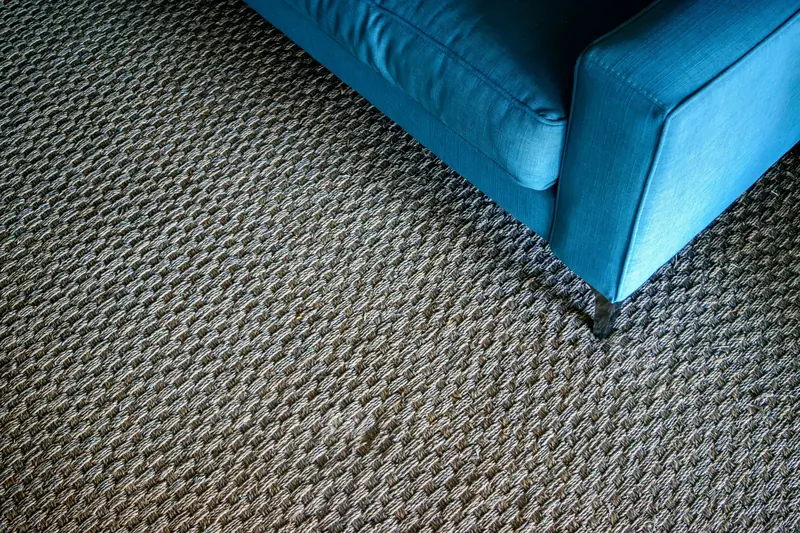
Keith has fitted more staircases than he could count, and he will tell anyone who asks that stairs are where cheap carpet shows itself first. Every step is trodden on in the same place, the edge of each step is bent around a nosing, and grit gets carried up from the hall. A carpet that would last fifteen years in a bedroom can look tired on the stairs in five.
So it is worth choosing stair carpet slightly differently from the rest of the house.
Pile and fibre
Wool and wool-rich carpets are our usual recommendation for stairs. Wool fibres are springy and recover from being crushed, so the carpet doesn't flatten as quickly on the front of each tread. Most of the stair carpets we sell are 80% wool and 20% nylon, which combines wool's resilience with nylon's strength.
Nylon is the best-wearing synthetic and a good choice if you want a soft, easy-clean carpet without wool.
Polypropylene is hard-wearing and stain-resistant, and good value, but it tends to flatten faster than wool or nylon on stairs. It is fine for stairs that don't get much traffic, such as up to a loft room, and in rental properties where it may be replaced in a few years anyway.
Twists (cut pile with the yarn tightly twisted) are a safe choice for stairs. They wear well and hide footprints.
Loop pile carpets can look very smart on stairs and wear well, but there are two things to know. First, pets' claws catch in loops and pull them. On stairs, where a dog is pushing off with its back feet, it happens more. Second, some loop carpets show a "grin" on the nosing, where the backing shows between the rows of loops as the carpet bends round the edge. We can show you how a particular carpet looks bent over a step in the showroom.
Very long or shaggy piles look lovely on a bedroom floor but are hard to fit neatly on stairs and can be a slip risk.
Colour
Very light carpets show dirt on stairs faster than anywhere else. Very dark plain carpets show fluff and lint. Mid tones, heathers (with flecks of colour) and slightly textured carpets hide the most. If your stairs come straight off the front door, think about what gets walked in.
Underlay
Stairs are where we always recommend our better grades of underlay. The nosing of each step takes a lot of pressure, and good underlay takes some of it off the carpet. A firm underlay is better than a very soft, thick one on stairs, because too much give makes the carpet move over the nosing and wear quickly. We'll suggest the right one when we measure.
Waterfall or Hollywood
There are two ways to fit carpet to the stairs themselves.
Waterfall fitting runs the carpet over the nosing of each step and straight down to the back of the tread below, so it hangs in front of the riser rather than following it. It is quicker to fit and works with almost any carpet. It is the most common way to fit stairs.
Hollywood fitting (sometimes called upholstered) wraps the carpet tightly around each nosing and fixes it into the angle under it, so the carpet follows the exact shape of every step. It looks crisp and tailored, particularly on stairs with a pronounced nosing. It takes longer and suits some carpets better than others. Thick or stiff carpets can be difficult to fit this way.
Runners
A runner covers the middle of the stairs and leaves the edges of each step showing, either painted or in natural wood. It suits older houses with good staircases, and it can be held in place with stair rods for a traditional look, or with hidden clips. The exposed edges will get scuffed over time, so they need to be painted or varnished with a tough floor finish before we fit.
Winders, landings and half-landings
Straight flights are the simplest. Winders, the triangular steps where a staircase turns a corner, need each step cut and fitted individually, so they take longer and use more carpet. Landings are fitted as a small room, often with a join where the stairs meet them. We plan where each join will go at the measure.
That is why our guide price for stairs is £15 per step for a straight flight, while winders and landings are measured and priced individually.
Safety
Stairs are where falls happen, so a few things matter more than looks:
- The carpet must be firmly fixed to every step. On a loose carpet, a foot can slide off the nosing.
- Choose a pile that is not too long or slippery.
- Very busy patterns and plain dark colours can make the edge of each step harder to see, especially for older eyes. A carpet with some contrast, or a lighter tone, helps.
- If the stair carpet starts to feel loose or moves under your foot, ring us. On a carpet we have fitted, it is covered by our two-year fitting guarantee.
Do the stairs, hall and landing match?
Usually people choose one carpet for the hall, stairs and landing, which makes them read as one space. If you're carpeting the bedrooms at the same time, the landing carpet can continue into them, or change at each door with a door bar. There is no right answer, but if you're unsure, come in and look at the samples side by side.
Before fitting
Clear the stairs and landing completely, including stair gates, which will need taking down. Stair gates can be refitted afterwards, but the fixings might need adjusting to suit the new carpet. If you have a stairlift, tell us at the measure. We can carpet around most stairlift rails, but it takes extra time.
Fitting a staircase and landing takes most of a day. You can use the stairs as soon as we've finished.